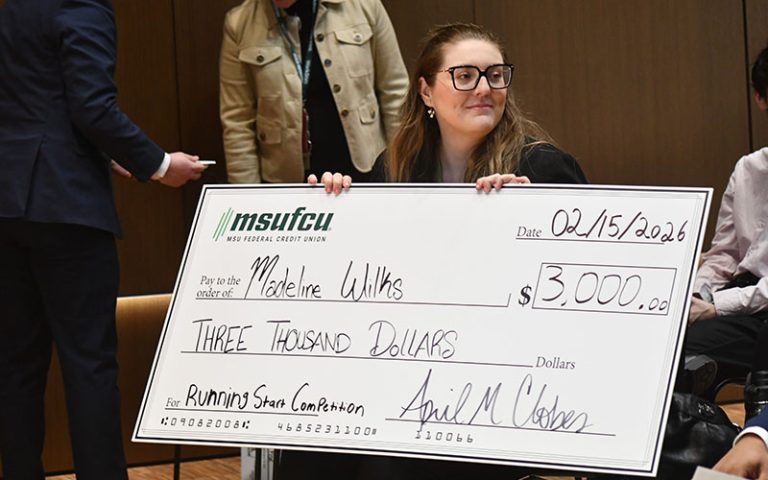
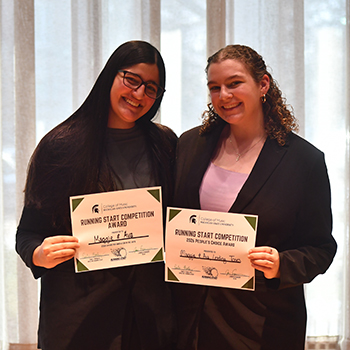
Each year, the Running Start Competition provides College of Music students with a unique opportunity to explore creative ideas, learn how to bring them to market, and make a pitch for funding in front of judges. Among the eight finalists – all of whom earned some level of financial support – bassoonist and DMA candidate Madeline Wilks took top honors for her development of the Tutti Strap, an adaptive instrument support system designed to improve comfort, fit, and accessibility for musicians of all body types, identities, and physical abilities.
The following is an edited transcript of a video featuring Wilks, filmed shortly following the Live Pitch portion of the competition in January.
What inspired you to start developing the Tutti Strap?
Over the course of all my experiences, the biggest thing I’ve learned is this: the biggest barrier isn’t actually talent. It’s the gear.
Traditional instrument supports often neglect those who have diverse body types. This includes women, nonbinary individuals, plus size, and disabled. The industry uses this male-centric “one-size-fits-all” [approach]. For an industry that’s built on creativity and inclusion, it’s surprisingly exclusive, and that gap is exactly what my project is attempting to alleviate.
I actually went on a large weight loss journey over the last few years. I lost 120lbs, and prior to that, I actually could not stand and play. It wasn’t for a lack of desire, and it often excluded me from different performance opportunities – some of which were paid or competitions – simply because the gear didn’t exist so that I could stand and play. I’ve spoken to so many female and plus size musicians, and it’s a common issue. We’re excluded from performances and competitions, and it’s really unfortunate because in the modern era, standing performance is more prevalent than ever. Many ensembles actually require it, but the gear is just not acceptable.
How will you use the funding?
At this stage, Tutti is focused on validation and readiness for scale, so the funds from [the Running Start Competition] will enable three critical steps to completing the project:
To create a fully functional and ergonomic prototype designed specifically for musicians who have historically been excluded from traditional instrument support systems.
To fund user testing with women and musicians of diverse body types. These trials are going to document not only the physical outcomes such as reduced strain and improved endurance, but also things like confidence and performance ability while using the strap. By collecting real data from historically underserved musicians, Tutti is going to center their experiences as the standard and not the exception.
To help me document specifications from the manufacturing process so that this is not a one-off solution, but a sustainable and accessible product.
What did you learn from competing in the Running Start Competition Live Pitch?
The Running Start Competition really pushed me outside of my comfort zone. I’ve been focused the last few years on performance and the pedagogical side of the music [industry], but it’s really important to dabble in a variety of different disciplines as a musician in order to have a sustainable career in this field. Running Start was a way for me to break into the music business side of things in a comfortable and safe environment while also learning a lot about how businesses work, writing a business plan, and taking a concept or an idea and making it a validated and legitimate product. It’s definitely been a learning experience for me so far but definitely one that I would do again.
What advice would you give to get students out of their comfort zones?
In regard to the Running Start Competition, I think that it’s really important to take whatever idea you have and try to turn it into something special. If you see a need or you see something that’s not being accomplished or something that’s not inclusive in the music [industry], do something about it, and go for the competition. There is no downside to learning something like this, and there’s no downside to taking an idea and making it a reality.
How has Running Start contributed to your success as a student at the MSU College of Music?
We are very fortunate here at MSU to have such a large array of different resources that are all completely free and a part of the student experience. As soon as I went to [College of Music Director of Career Education and Music Entrepreneurship] Emily Henley at the Running Start office and said, ‘this is an idea that I would like to take to the competition,’ the first thing she said was, ‘let’s sit down and talk about it.’ She recommended that I sign up with the Burgess Institute. So, I immediately did, and they helped me write my business plan which opened up a whole pathway to all kinds of different resources.
What was it like to collaborate with the Burgess Institute?
The Burgess Institute was a great resource for making this project. [They] introduced me to what a business plan is, the financial side of a business, and they also helped me legally with the patenting and trademark of my idea. It’s really a joy to know that my idea is protected and that I have the legal and financial resources backing this idea [when] I’m taking it to an international competition or to the next steps of business creation.
What do you think others would gain from collaborating with the Burgess Institute?
The Burgess institute opened up a pathway to an entire network of resources that are specific to business. I did not know anything about it going into this, so having that resource with industry professionals [experienced in] competitions and resources was really helpful for the creation of my project.
2026 Live Pitch Judges
- Belle Coty | Manager of Special Events at Aspen Music Festival and School
- Damien Crutcher | co-founder and CEO of Crescendo Detroit and artistic director and conductor of the Farmington Community Band
- Kristin Pagels-Quinlan | Senior Analyst at Capacity Interactive
- Christian Hebel | world-renowned violinist and music entrepreneur
- Quinton Morris | Executive Director & Founder of The Key to Change
Sponsorship and Support
This event is made possible thanks to the generous support of the MSU Federal Credit Union and donor Kim Kleasen.
This content originally appeared on the College of Music's website.